
We’ve spent the last several posts telling you to automate your own work. So it’s fair to stop and ask: if you build the thing that does your job, what stops someone from noticing they no longer need you? There’s a name for this now: FOBO, fear of becoming obsolete. Not the general worry that AI might replace jobs someday. The specific, present-tense feeling that your own skills are aging out in real time and the window to stay relevant is closing while you read this. The fear of AI replacing jobs at work is real. Let’s just say it out loud.
AI Replacing Jobs at Work: The Honest Answer First
Here’s the honest answer first, because the rest of this post is worthless if I soften this part.
Yes. Some jobs are going away. If a role is nothing but moving data from one place to another by hand, that role is at real risk, and no amount of reassurance changes that. Manual data entry, copy this field into that system, retype the numbers from the PDF into the spreadsheet. That work is exactly what these tools do well, and they do it without lunch breaks. Anyone telling you otherwise is selling something or scared to say it out loud. I’m not going to do that.
But notice the specific thing that’s at risk. It’s the task. Not the person who understands the task well enough to direct it.
That distinction isn’t comforting wordplay. It’s the actual mechanism. A task is a fixed set of steps: pull this, format it like that, send it here. AI is extremely good at fixed steps, because fixed steps don’t require judgment, only execution. A job, on the other hand, is a moving target made up of many tasks plus the ongoing decisions about which tasks matter this week, what changed since last time, and what to do when the situation doesn’t match any of the steps you wrote down. Automating the first part doesn’t touch the second part. It just makes the second part the whole job, instead of the part you got to occasionally when the busywork let you.
A few posts back, in What Is Actually Worth Automating, you saw what that gap looks like in practice: AI can read a transcript of a meeting, not the room it happened in. That’s not a coincidence specific to meetings. It’s the general shape of what actually survives automation, and it’s the same gap you’re being asked to trust here.
What I Actually Tell People Who Are Scared
I’ve never personally been scared of automating myself out of a job. Not because I’m unusually confident. Because I’ve watched what actually happens when a task gets automated, and it’s never the whole job.
Here’s something I keep turning over: we’ve been hammered with the idea that we’re always expendable since long before AI showed up. Someone else has always been out there who could step in and take over your job. Is that really news? So why does this feel scarier? Maybe it’s because if a person replaces you, there’s still a body getting paid. If AI does it, there isn’t. I’m not sure that’s the actual difference. I don’t dwell on it too much. I’m more focused on what I need to do next.
Here’s what I actually tell them, because it’s real and it’s not a pep talk: if I could create a prompt that did your job, we would be doing that already. That’s just the facts, and it’s not reality. Have I seen jobs replaced? Yes. Note-taking roles. Data-entry-exclusive positions. But jobs that take someone knowing what they’re looking for and directing the AI toward it? No — and not because the tools aren’t good enough. Because that part isn’t a task. It’s judgment, and judgment is exactly what you bring to the build that the tool can’t.
The person who automates their own work and becomes the auditor isn’t the one in danger. The person in danger is the one who never learned the tool at all.
Quiet Rehiring
Lately I’ve been reading about “quiet rehiring.” Companies that laid people off, betting AI could cover the gap, quietly bringing some of those same people back months later.
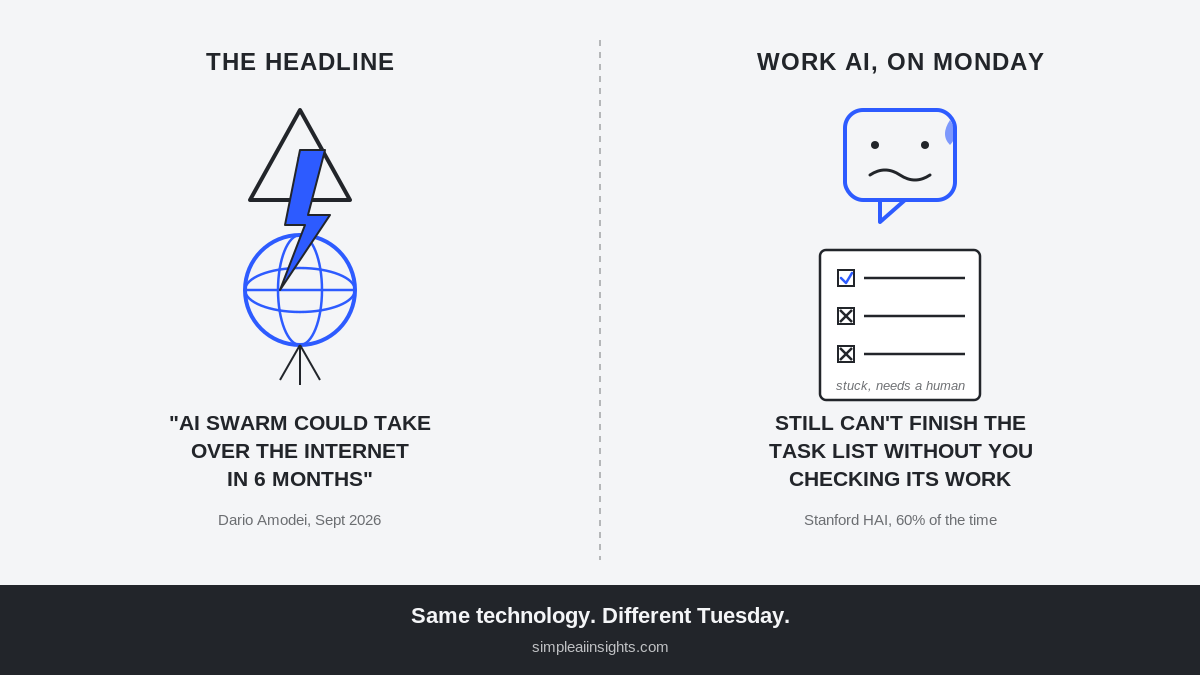
It reads like a painful experiment to see how much AI could actually replace, because that’s what it was. Painful because it’s people’s actual livelihoods. Ford reportedly rehired hundreds of engineers after its AI quality-control system missed defects a trained eye would have caught. Klarna’s CEO said publicly that cutting too deep into human support hurt the customer experience enough to reverse it. Gartner is predicting that half of companies who cut staff citing AI will be rehiring for similar functions by 2027.
The pattern underneath all of it is the same: teams got cut down assuming AI could fully cover the gap, and then the people who were left couldn’t keep up with demand. AI still needs babysitting and review. It’s not a leave-it-and-forget-it state.
Does that mean industry leaders give up on chasing this kind of automation? Highly unlikely.
The Part AI Still Can’t Touch
Here’s what I keep coming back to when people ask me what’s actually safe: AI can’t replace networking. It can’t replace connecting people. All the actual human stuff, it still can’t do that.
Part of that is systems thinking, and I don’t mean the technical kind. I mean knowing how something should actually work because you understand the people receiving the output, how they’ll interact with it, what they’ll do with it next. AI can’t do that. Not today, anyway. It doesn’t know your company’s people the way you do.
So the real question isn’t whether AI replaces you. It’s whether you figure out how to bring value with the tool.
For some of you, that means figuring out how to bring more value to the visionaries in your company, the people whose job is to see what’s next, so they can come up with even more of what drives the business forward. It means letting your customer-facing people show up more present and more prepared, because the busywork that used to eat their prep time is gone.
And if you’re not customer-facing, if you’re not the visionary in the room, does that make you more replaceable? No. You’re the one who knows what those people actually need to make those interactions better.
The Real Move Is to Get Ahead of It
So here’s what I’d actually tell you to do instead of just worrying about AI replacing jobs at work. Learn the tool. Not casually, not “I’ll get around to it eventually.” Actually sit down and figure out how to direct it well.
The people who get replaced aren’t the ones using AI badly. If you know how to direct the tool better than the person next to you, you’re not competing with AI. You’re the one companies want running it: someone who can point it at the right problem, catch it when it’s wrong, and save the workflow so the rest of the team can use it too. That’s a better seat than the one you had before.
Does This Take the Fun Out of the Job?
Here’s a harder question, and I don’t have a clean answer for it. If part of why you chose your career is that you genuinely enjoy the work, what happens when AI starts doing the part you enjoy? Someone who became a developer because they love writing code has a real reason to be uneasy about handing that part over, and “just automate it” isn’t a satisfying answer to that. This is a real debate, not a settled one, and I’m not going to pretend I have all the answers.
But I think the question worth asking isn’t “should AI touch this at all.” It’s “which parts of my job do I actually enjoy, and which parts am I just getting through.” Start with the second pile, not the first. Automating the parts you don’t enjoy protects the parts you do, instead of automating everything indiscriminately and hoping it works out in your favor.
For me, that tension actually cuts the other way. Getting AI to give me its best result on the first try has turned into something close to a game. I own more board games than I probably should, and pushing on a prompt until it lands feels like the same kind of puzzle to me.
But I know that’s not fun for everyone. It can be genuinely frustrating when AI seems to hold back its best answer until you push it, redirect it, ask again. Not lying exactly, but close enough to feel that way when you just wanted the right answer the first time. If that’s your experience, you’re not doing it wrong. You just need to find the way of working with the tool that actually works for you, not the way that works for me.
Start With What You Hate
If you’re like me, there are things you just hate doing. I have a short list of tasks I will find literally anything else to do before I sit down and do them. Email. A different task that suddenly feels urgent. Anything, for as long as I can get away with it.
That avoidance is usually a decent signal. If you keep finding reasons not to do something, ask whether it can be automated instead of white-knuckling through it every time. Not everything you hate is automatable, but a surprising amount of it is exactly the kind of fixed, repeatable task AI is actually good at.
Start the Log Now
You already found the first real candidate: the thing you hate. Here’s how to actually track it.
Start logging your workflows. What Is Actually Worth Automating covered how to build the log. If you skipped it then, start it now: what you actually do, where the data lives, how long it takes, what comes out at the end. One row per task, kept current.
You’re not doing this for a productivity badge. You’re doing it because the log is what you point to later, when you need to make the case for what you built. What it actually did.
The log is also the fastest way to answer the fear of AI replacing jobs at work directly, instead of just reasoning your way around it.
The actual prompt: “Here’s my workflow log and a plain description of my job. Sort my work into two lists: the parts that are fixed steps a tool could run today, and the parts that require judgment, context, or someone being accountable for the call. Be blunt about the first list. That’s what I’m automating next. The second list is my actual job. Tell me if it’s thinner than I think it is, and what I’d need to build to make it thicker.”
Next up: you’ve logged your workflows, you’ve built them, and they’re running. The next question is how you prove to leadership it was worth it, and that’s a harder case than most people expect.

Leave a Reply